BrumeBlog.com Review: Clean Content, Wide Categories, and a Narrow Trust Layer

By Smiley
Updated May 26, 2026
BrumeBlog.com does not look suspicious at first. The layout is clean, the categories are familiar, and the writing is easy to follow. It presents itself as a digital magazine for readers who want explanations across business, education, finance, health, lifestyle, technology, and travel.
When you stop judging it by design and start reading it as a publishing system, the impression shifts. BrumeBlog.com has the frame of a broad online magazine, yet its author layer, category depth, and editorial signals feel closer to a small multi‑topic blog. That does not make the site unusable, but it does mean it needs to be read with the right expectations.
The fairest way to read BrumeBlog.com is this: it is a clean and accessible general blog, but its visible trust layer is thinner than its editorial promise.
The Magazine Mask

BrumeBlog.com uses a familiar digital‑magazine structure. The category spread is wide: Business, Education, Finance, Health, Lifestyle, Technology, and Travel. On the surface, that creates a strong first impression. A reader sees multiple sections and assumes the site has the capacity to support each one with meaningful coverage.
The structure is genuinely useful for navigation. It signals what kind of content a visitor might find and makes the site feel organized. For casual browsing, the setup works: a user looking for a business explainer, a health intro, or a travel piece can move between sections without friction.
The issue is not the number of categories. A broad blog can work if the editorial system behind it is robust. The real test is whether BrumeBlog.com has the author expertise, content depth, publishing consistency, and review habits needed to sustain such a wide scope.
That is where the site starts to feel smaller than its magazine‑style frame.
The Small‑Blog Reality
Once you move past the menu and into the articles, BrumeBlog.com feels less like a full‑scale digital magazine and more like a compact multi‑niche blog. The posts are structured and readable, but they tend to stay at an introductory level. The site can explain concepts, yet it rarely moves into deep analysis, original research, expert interviews, or documented testing.
This gap matters because the site touches subjects with very different stakes. A lifestyle piece can be light and still functional. A travel piece can rely on general context. Finance, health, and certain technology topics require tighter handling because readers might act on the information.
Functionally, the site works as a general informational publisher. It is not a tool‑based platform, not a software service, and not a specialized newsroom. It is a multi‑category content site built around readable articles.
That purpose is legitimate, but BrumeBlog.com should be judged as a general reading blog rather than as a specialist authority.
Information Architecture and UX
From a user‑experience point of view, BrumeBlog.com does several things well. The site loads cleanly, the typography is readable, and posts are broken into digestible sections. There is no feeling of being trapped in ad labyrinths or pop‑up storms.
Navigation is straightforward:
- A primary menu for main categories.
- Article pages with clear titles, intro paragraphs, and subheadings.
- Basic internal linking that occasionally nudges readers toward related topics.
Where it feels less mature is in advanced UX touches that serious editorial brands often use: stronger in‑article navigation, clear “last updated” stamps on time‑sensitive pieces, or distinct visual treatments for high‑risk topics like health and finance. Right now, health tips and lifestyle ideas can look structurally similar, even though their consequences differ.
Author Layer and Category Fit

The author layer is one of the clearest trust clues on BrumeBlog.com. The site is not completely faceless, which works in its favor. Devin Haney has a visible profile bio, adding at least one identifiable voice and a basic sense of accountability.
At the same time, the visible author pool is narrow for the number of categories involved. With only two authors appearing across all sections and only one having a proper profile, the “who is behind this?” story feels thin for a site that spans finance, health, business, education, lifestyle, technology, and travel.
Readers need a way to connect expertise with subject matter. They should be able to see whether a finance article is written by someone with financial background, or whether a health post reflects more than generic overview knowledge. BrumeBlog.com does not clearly provide that mapping.
Author signal snapshot
| Author signal | What it tells the reader |
| Devin Haney has a visible bio | At least one real person is attached to part of the site |
| Second author visible but shallow | Limited sense of who else is contributing |
| Same authors across many categories | Thin expertise distribution across complex topics |
| No clear category specialists | Hard to trust depth in finance/health/tech posts |
The issue is not that the authors lack competence; the issue is that the site offers too little evidence for readers to judge that competence by subject.
Category Width vs Category Weight
BrumeBlog.com clearly has category width. It covers a lot of ground, but width is not the same as authority. The existence of a Business or Health tab does not automatically mean those sections are backed by subject‑matter depth.
Strong multi‑category publications usually show one or more of the following: specialist writers aligned to beats, expert reviewers attached to sensitive topics, or visible editorial processes. BrumeBlog.com does not make these layers obvious. As a result, its categories read more like content lanes than like fully formed desks.
Business, finance, health, lifestyle, technology, education, and travel all sit under a single brand umbrella. That gives the site reach and search range, but it also raises the trust bar. A reader should not have to guess whether a health article was treated differently from a lifestyle listicle, or whether a finance post went through a stricter review.
Category picture
| Category | Apparent depth |
| Business | Introductory, concept‑level |
| Finance | Needs clearer expertise signal |
| Health | Light, overview‑oriented |
| Technology | General explainers, not testing |
| Education | Guidance, not research‑driven |
| Lifestyle | Most naturally aligned with tone |
| Travel | Feels comparatively thinner |
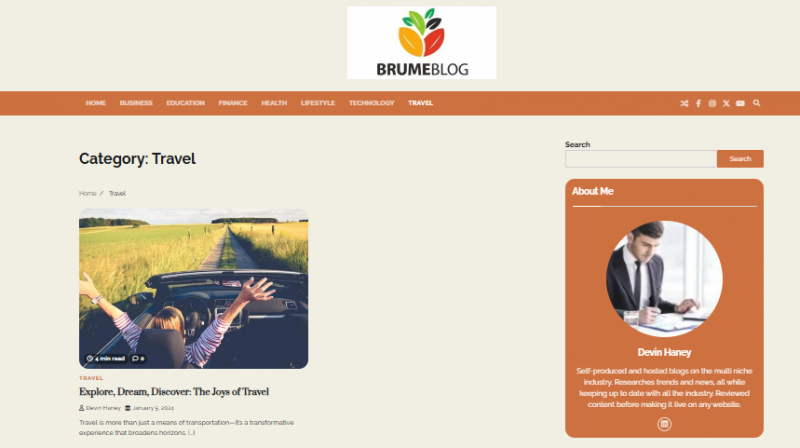
In practice, BrumeBlog.com feels like a compact operation stretched across wide categories. The structure suggests a magazine; the visible infrastructure suggests a small blog.
Easy to Read, Easy to Outgrow
The writing is both a strength and a ceiling. It is simple, clean, and straightforward. A casual reader can move through articles without specialist vocabulary or heavy jargon. This is ideal for quick introductions and first‑time explanations.
The same simplicity makes the content easy to outgrow. Articles often summarize concepts instead of demonstrating them. There is little use of data, original testing, concrete case studies, or side‑by‑side comparisons. Expert voices and cited sources are not consistently foregrounded.
For beginners, BrumeBlog.com can act as a decent entry ramp. For readers looking for decision‑ready information, it tends to stop one level too early.
Content feel
| Dimension | Assessment |
| Readability | Strong |
| Beginner usefulness | Reasonable |
| Original reporting | Limited |
| Expert sourcing | Weak |
| Practical depth | Moderate to light |
| Best suited for | Introductory learning |
The site is not difficult to follow. The strain appears when a reader needs more than surface‑level clarity.
Active, but Not Deeply Balanced
BrumeBlog.com does not look abandoned. Newer pieces appear on the site, and the overall structure is set up for continued publishing. This alone distinguishes it from parked domains or stale blogs.
However, activity is not the same as editorial maturity. The more telling question is how evenly the categories grow. Some areas appear more built out; others, such as Travel, feel thinner by comparison. This pattern fits the profile of a growing multi‑niche blog rather than a fully balanced digital magazine.
Uneven depth is common on compact teams. The tension arises when the visual frame promises equal weight across multiple sections. When a site presents itself as a broad magazine but some verticals look like side notes, the overall authority drops a notch.
BrumeBlog.com is active enough to matter, but not yet even enough to feel like a mature multi‑section publication.
What the Site Is Really Built For
BrumeBlog.com appears designed to capture broad informational interest across everyday search topics and to present that information in a straightforward way. Its core product is the article, not a service or a tool.
There is no visible dashboard, no app‑like workflow, and no evident software layer; users come to read, not to perform actions. The site’s value is in orienting readers, not in executing tasks for them.
Seen through that lens, the site works best as a casual reading hub. It can help someone understand a concept, pick up basic terminology, or get a sense of what a topic involves. It is much less suited to being the only source for decisions in sensitive domains.
BrumeBlog.com is not weak because it is broad. It feels limited because the visible author and editorial structure does not fully match the range of its subject claims.
Where It Earns Trust
For a general blog, BrumeBlog.com does several things right. The design is clean, navigation is intuitive, and the articles look like they were written for humans rather than stuffed purely for robots. There is enough structure to move around without getting lost.
The presence of a real bio for Devin Haney lifts the site above anonymous, purely programmatic setups. Many low‑effort properties never show any human attribution. Here, at least part of the content has a visible owner.
The language is also appropriately pitched. It invites readers who want clarity without academic density. That matters for people who are browsing on their phones, in between tasks, or from non‑technical backgrounds.
As a starting point for exploration, BrumeBlog.com is credible enough to enter the conversation.
Where Trust Gets Thin
Trust begins to strain when the questions become more specific. Who wrote each individual article? What is their experience in that domain? Was any piece reviewed by someone else? Are health‑related posts handled differently from lifestyle round‑ups? Are finance articles checked against current regulations or best practices? How often are older posts revisited and updated?
Those questions matter because not all categories carry the same weight. Lifestyle tips can be relaxed. Health, finance, and some technology topics have direct implications for risk, money, or well‑being. Treating them with the same light editorial touch is not enough.
BrumeBlog.com does not currently show a robust trust infrastructure around these differences. The author layer is narrow, editorial standards are not prominently outlined, and formal sourcing is light. That leaves readers with more responsibility to verify critical information themselves.
The site remains readable; it is not fully accountable in a way that matches its category spread.
How It Handles Higher‑Risk Topics
One area BrumeBlog.com could develop further is the way it handles sensitive and advice‑heavy content. When a site covers finance, health, or career topics, readers need more than access; they need context and guardrails.
A more mature approach would include:
- Clear disclaimers on financial and health‑related posts.
- Short notes confirming content is informational, not personalized advice.
- Visible update dates and revision notes on articles that can age quickly.
- Stronger visual separation between light lifestyle pieces and guidance that can influence serious decisions.
Right now, BrumeBlog.com presents these topics within the same general structure used for lower‑risk content. Without additional framing, readers must make their own risk judgment on every page. For a multi‑topic site, this missing trust layer becomes noticeable as soon as the subject touches money, health, or long‑term planning.
Practical Reader Use Cases
Used thoughtfully, BrumeBlog.com can still play a useful role in a reader’s information diet. It is particularly suited to:
- Getting a quick overview of a topic you’ve never looked into before.
- Picking up basic terminology before you move to more technical sources.
- Exploring lifestyle and productivity ideas where stakes are low.
- Using it as a first stop, not a last stop, on multi‑step research.
It is poorly suited to:
- Making health decisions based solely on a single article.
- Choosing financial products or strategies without cross‑checking elsewhere.
- Designing technical implementations where errors are costly.
- Treating any one post as full professional guidance.
The Review Lens
If you describe BrumeBlog.com only as a multi‑niche blog, you capture its shape but not its dynamics. A review should focus on the gap between the site’s polished magazine‑style surface and the much slimmer support system underneath.
| Lens element | Finding |
| Surface identity | Clean multi‑category blog / magazine frame |
| Real function | General informational publisher |
| Best reader fit | Casual readers and beginners |
| Main strength | Readable, accessible content across topics |
| Main weakness | Narrow author and editorial layer |
| Risk hot‑spots | Health, finance, and technical guidance |
| Overall position | Useful, but not a specialist‑level reference |
BrumeBlog.com occupies the middle ground: worthy of attention for light reading, but not built for high‑stakes reliance.
Final Verdict
BrumeBlog.com is best seen as a clean, small multi-niche blog with a magazine-style frame. It publishes readable articles across business, finance, health, technology, education, lifestyle, and travel, making it useful for casual browsing and basic explanations.
Its main limitation is authority. The site covers many categories, but the visible author layer is narrow, with only one properly developed profile. That creates an accountability gap, especially in sensitive areas like finance, health, and technical advice.
The issue is not that BrumeBlog.com is broad. The issue is that its trust signals are not strong enough for the scope it presents. It works as a general reading blog, but readers should verify important claims through stronger expert-backed sources before relying on them.

_1781527674.jpg)