DecoratorAdvice.com Review: Helpful Home Ideas, But Not a Pure Home Authority

By Smiley
Updated May 23, 2026
DecoratorAdvice.com looks like a home decor and improvement blog at first glance, and much of its content supports that identity. It covers interiors, exterior design, DIY tips, renovation ideas, home maintenance, roofing, gutters, HVAC, staging, garden preparation, and practical homeowner topics. But a closer reading shows a second layer: casino, gaming, and partner-link content that does not naturally belong on a home advice website.
That does not make DecoratorAdvice.com useless. It does make it more complicated. The site is useful for casual home inspiration, but its editorial credibility becomes weaker when off-niche commercial content appears beside home improvement advice.
The Site’s Real Position
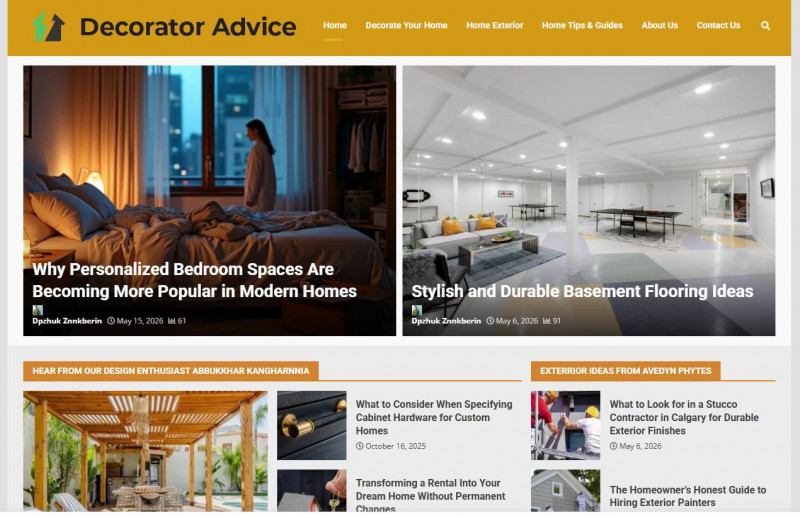
DecoratorAdvice.com is not a random multi-niche blog in the usual sense. Its main identity is clearly built around homes. The name, homepage direction, menu structure, and most visible topics point toward decor, DIY, exterior design, home services, and homeowner guidance.
That focus gives the site a stronger first impression than broad blogs that publish across unrelated categories without any clear theme. A reader looking for styling ideas, rental decor tips, wall art inspiration, roofing guidance, or garden preparation can understand the site’s purpose quickly.
The issue is that the site does not fully stay inside that identity. Casino, online pokies, blackjack, online games, and gaming-related partner links create a clear editorial mismatch. A home advice website can expand into lifestyle topics, but gambling and casino content sits too far away from its core promise.
So the accurate description is this: DecoratorAdvice.com is a home-focused blog with a visible commercial/off-niche publishing layer.
What the Content Mix Reveals
A website’s content mix often says more than its tagline. DecoratorAdvice.com says “home advice” through its branding, but its archive and footer suggest a broader publishing model.
| Content Area | How It Fits the Site | What It Reveals |
| Interior decor | Strong fit | Supports the site’s main identity |
| Exterior design | Strong fit | Matches homeowner interest |
| DIY and home tips | Strong fit | Useful for practical, casual readers |
| Roofing, gutters, HVAC, plumbing | Relevant, but higher-risk | Needs stronger expert review and technical accuracy |
| Renovation and staging | Good fit | Valuable if backed by examples and real guidance |
| Home services and brand-led posts | Mixed | Can feel useful or promotional depending on disclosure |
| Casino and gaming posts | Weak fit | Dilutes the home decor identity |
| Footer casino/gaming partner links | Major mismatch | Suggests commercial relationships beyond the home niche |
The core home content is not the problem. The problem is editorial contamination. When a site that presents itself as a decor resource also carries gambling-related material, readers start questioning how strict its content standards are.
The Good Part: It Understands Casual Home Readers
DecoratorAdvice.com works best when it stays close to home inspiration. Its articles appear designed for quick reading. The style is simple, direct, and built around common homeowner questions. That is useful for readers who want ideas without technical complexity.
For topics like bedroom styling, wall decor, rental-friendly interiors, garden preparation, storage ideas, or home office setup, this approach makes sense. Readers do not always need a 2,000-word expert report to choose a design direction. Sometimes they need a few usable ideas and a basic explanation.
This is where the site has value. It offers accessible content for readers who want starting points, not specialist consultation. Its strength is not deep authority. Its strength is low-friction inspiration.
The Weak Part: Technical Advice Needs More Proof
DecoratorAdvice.com becomes less convincing when it enters technical home improvement territory. Roofing, HVAC repair, plumbing, gutters, insurance, renovation planning, storm damage, and contractor-related topics are not the same as color palettes or bedroom decor.
These topics affect money, safety, property value, and sometimes legal compliance. A short article can introduce the subject, but it should not replace professional guidance.
| Topic Type | Reader Risk | What the Site Should Ideally Provide |
| Decor ideas | Low | Visual examples, style tips, practical suggestions |
| DIY styling | Low to medium | Clear steps, limitations, safety notes |
| Gardening and outdoor setup | Medium | Seasonal context, regional caveats |
| Roofing and gutters | High | Expert review, safety warnings, repair cost context |
| HVAC and plumbing | High | Professional guidance, when-to-call-a-technician advice |
| Insurance and contractor topics | High | Disclosure, source clarity, jurisdiction awareness |
| Casino/gaming posts | Off-topic | Clear separation from home content |
The site is more reliable as an idea source than as a decision source. That distinction should be central to any review.
Writing Style: Clean, But Often Formula-Led
The writing style is easy to follow. Articles usually appear to use clear headings, simple explanations, short sections, and practical framing. That helps casual readers move through the content quickly.
However, the style can feel formula-led. Many posts seem built around search intent rather than strong editorial judgement. The structure often reads like a standard content template: introduce the topic, explain why it matters, list common tips, then close with a simple takeaway.
That is not automatically bad. Search-friendly writing can still be useful. But it becomes a limitation when the site covers complex home improvement subjects. A serious article on HVAC repair, roofing, or storm damage should show more than general advice. It should include safety signals, examples, cost ranges, expert input, or clearer practical boundaries.
The writing is readable. It is not consistently authoritative.
Expertise: The Missing Layer
DecoratorAdvice.com presents itself with confidence, but expertise is not just a tone. It must be visible.
For a home decor article, general writing may be enough. For technical topics, readers should see stronger trust markers. These may include author credentials, designer input, contractor review, editorial standards, update dates, source notes, or disclaimers.
The site’s current weakness is that it does not clearly separate casual advice from professional-grade guidance. A post about arranging furniture and a post about HVAC repair should not carry the same trust burden. One is about preference. The other may involve safety and cost.
| Expertise Signal | Why It Matters | Current Concern |
| Author credentials | Shows topic knowledge | Not strong enough for technical areas |
| Expert review | Adds credibility to repair and renovation advice | Not clearly visible |
| Editorial policy | Explains how content is checked | Needs clearer presentation |
| Sponsored disclosure | Protects reader trust | Especially important with partner links |
| Topic alignment | Builds authority over time | Weakened by casino/gaming content |
| Technical caution | Prevents risky DIY interpretation | Needed for HVAC, plumbing, roofing |
DecoratorAdvice.com does not need to be perfect to be useful. But if it wants to be trusted as a home improvement authority, it needs a clearer expertise layer.
The Footer Problem

The casino and gaming partner links in the footer are one of the most important trust signals on the site. Footer links are not like one random article buried in the archive. They appear across the site and become part of the domain’s structure.
For a home decor website, that matters. A reader may forgive one unrelated guest post. But site-wide gaming or casino partner links suggest a more intentional commercial relationship. That can mean sponsorship, affiliate placement, SEO partnership, paid links, or broader monetization activity.
The concern is not simply that casino content exists. The concern is that it sits inside a website that asks readers to trust it on home-related advice. A niche site builds authority by staying consistent. Off-niche footer links pull the brand away from that consistency.
Transparency and Reliability
DecoratorAdvice.com has some basic transparency signals. It has a recognizable website structure, contact-style information, legal pages, and a clear home-focused brand direction. That gives it more credibility than anonymous throwaway blogs.
But transparency is incomplete. The site should do more to explain who writes the content, how technical advice is reviewed, how sponsored or partner links are handled, and whether off-niche posts are paid placements.
| Transparency Area | Current Reading | Review Impact |
| Contact information | Present | Positive basic signal |
| Legal pages | Present | Adds formal structure |
| Home-focused branding | Clear | Helps readers understand the main niche |
| Partner links | Present in footer | Needs stronger disclosure |
| Author expertise | Not strongly visible | Weakens technical trust |
| Editorial standards | Not clearly explained | Makes quality control harder to judge |
| Off-topic posts | Visible | Reduces niche reliability |
Reliability, therefore, depends on the topic. For decor inspiration, the site is reasonably useful. For technical repair, contractor, safety, insurance, or renovation decisions, readers should verify information elsewhere.
Strengths vs Weaknesses
| Strengths | Weaknesses |
| Clear home decor and improvement identity | Casino and gaming content weakens niche focus |
| Useful for casual home inspiration | Footer partner links create commercial trust concerns |
| Simple, readable article style | Technical content needs stronger expert review |
| Covers interiors, exteriors, DIY, and home maintenance | Some posts may feel guest-post or placement-driven |
| Easy for beginners to browse | Disclosure around sponsored or partner content is not strong enough |
| Helpful for low-risk decorating ideas | Not ideal as a final source for repair or safety decisions |
| More focused than broad multi-niche blogs | Editorial boundaries feel loose |
This is the fairest way to read the site: DecoratorAdvice.com has real usefulness, but its trust is uneven.
Who Should Use It?
DecoratorAdvice.com is best for readers who want light home ideas, decor inspiration, and beginner-friendly improvement tips. Renters, homeowners, DIY beginners, and casual design readers may find it useful when they are looking for starting points.
It is less suitable for readers who need professional-level guidance. If the topic involves HVAC, roofing, plumbing, insurance, structural work, contractor hiring, electrical issues, or major renovation planning, the site should be used only as an introduction.
| Reader Type | Fit | Why |
| Casual decor reader | Good fit | Easy ideas and simple styling content |
| Renter | Good fit | Useful for low-risk decorating inspiration |
| DIY beginner | Moderate fit | Helpful for basic ideas, but verify technical steps |
| Homeowner planning repairs | Limited fit | Needs professional confirmation |
| Contractor-level reader | Weak fit | Not technical enough |
| Reader avoiding gambling-linked sites | Weak fit | Footer and archive contain off-niche signals |
Final Assessment
DecoratorAdvice.com is a useful home inspiration blog, but not a fully clean home authority. Its best content serves readers looking for decor ideas, practical home tips, and simple improvement guidance. In that role, it can be helpful.
The concern is the site’s mixed editorial behaviour. Casino and gaming articles, footer partner links, commercial-looking content, and unclear expert-review standards weaken the trust profile. The site looks focused on home advice, but its deeper structure shows a broader monetization and publishing layer.
The best way to use DecoratorAdvice.com is as a starting point for ideas, not as a final source for serious home decisions. It can inspire a room refresh or introduce a maintenance topic, but readers should verify technical, safety, repair, insurance, and contractor-related advice with qualified sources.
Overall Rating: 6.1/10
| Review Area | Rating | Reason |
| Niche identity | 7/10 | Strong home focus on the surface |
| Readability | 7/10 | Simple and easy to scan |
| Content usefulness | 6.5/10 | Good for inspiration and basic tips |
| Content depth | 5/10 | Limited for technical home topics |
| Expertise signal | 4.5/10 | Needs clearer professional review |
| Transparency | 5/10 | Basic signals exist, but disclosures need work |
| Editorial consistency | 4/10 | Casino and gaming content dilute the brand |
| Overall | 6.1/10 | Useful home blog with visible trust gaps |