MagFuseHub.com Review: Broad Magazine Ambition, Uneven Content Reality

By Smiley
Updated May 15, 2026
MagFuseHub.com presents itself like a wide-angle digital publication. The category spread suggests a site that wants to speak across technology, finance, health, lifestyle, business, pets, travel, fashion, law, and more. At first glance, that looks like editorial ambition. On closer reading, it looks more like a search-led WordPress blog that is still trying to decide what it wants to become.
That gap between appearance and reality is the key to understanding the site. MagFuseHub is not a fully developed multi-beat magazine yet. It is a broad-structure content platform with uneven category development, an inconsistent publishing rhythm across sections, and one visible author identity covering everything.
MagFuseHub.com overview

Plainly put, MagFuseHub is a content website, not a tool, marketplace, software platform, or community product. Its value comes entirely from articles. It appears designed to attract informational search traffic, especially around practical topics, general explainers, and timely interest areas, rather than to build a strong subscriber-led readership model.
The site’s broad category structure signals scale, but the actual publishing pattern is narrower. A reader expecting ten fully alive editorial verticals will not find that. What they will find is a site where some categories are active, some are lightly maintained, and some are effectively decorative.
Category overview: what is actually active
The best way to read MagFuseHub is not by its navigation promise, but by its publishing behavior. The site may list many sections, but not all of them are carrying equal editorial weight.
At the moment, Pets appears to be the most recently active and most visibly pushed section, but that should not be mistaken for the historical or foundational identity of the domain. It looks more like the site has recently leaned heavily into Pets publishing, giving that section current momentum and homepage dominance. Finance and Health also show signs of activity. Technology exists, but with less consistency. Business, Lifestyle and Automotive feel thinner. Travel is barely maintained. Fashion and Law remain empty.
Here is the more accurate map:
| Category | Current state | Reading of the section |
| Pets | Recently very active | Currently the most pushed section, but not necessarily the site’s original core |
| Finance | Active | One of the stronger non-pet sections, with sharper topic selection |
| Health | Active | Readable and maintained, but broad and lightweight |
| Technology | Lightly active | Inconsistent, with uneven recency and focus |
| Business | Thin | Mixed intent, weak editorial discipline |
| Lifestyle | Thin | Broad, vague, and somewhat blurred with Health |
| Automotive | Thin | Present, but without much continuity |
| Travel | Neglected | Very low publishing volume, effectively dormant |
| Fashion | Empty | Category exists, no meaningful content |
| Law | Empty | Category exists, no meaningful content |
This matters because category volume tells you where the site is actually investing effort. Right now, MagFuseHub looks less like a balanced ten-section publication and more like a site testing where momentum can be built.
Publishing behavior: what the pattern reveals
Publishing behavior says more about a site than its tagline ever will. On MagFuseHub, the behavior suggests opportunistic expansion rather than a settled editorial plan.
A few things stand out:
- The site does not publish with equal commitment across categories.
- It appears to shift attention toward whatever content lane is being emphasized at a given moment.
- The recent weight behind Pets makes that section look central today, even if the domain itself was not originally built around it.
- Older or lightly maintained categories remain visible even when the publishing cadence has faded.
That combination usually points to a search-first strategy. Instead of building each category into a clear editorial vertical, the site seems to be allocating attention where content output is easiest, timely, or potentially traffic-friendly. That is why the homepage can become dominated by one section without the whole domain actually being a niche site.
In other words, MagFuseHub behaves like a generalist content platform experimenting in public. The categories are not equally edited channels; they are unevenly maintained content buckets.
What empty categories like Fashion and Law really mean
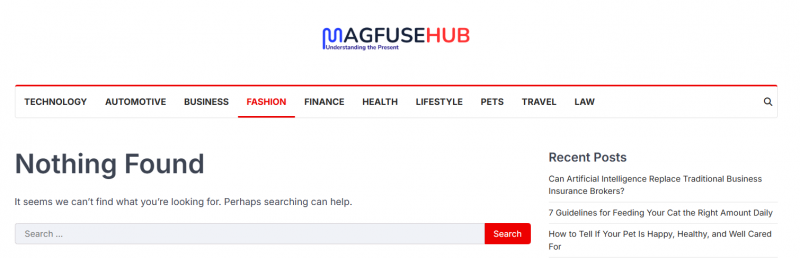
Fashion and Law are not simply “coming soon” ideas in a private roadmap. They exist in the public-facing structure without real content to support them. That is a very different thing.
When a category is visible but empty, it signals that the site wanted the topical footprint before it built the editorial depth. For readers, that creates immediate friction. A navigation bar is a promise. If a user clicks into Law expecting legal explainers and finds no real archive, that promise is broken.
More importantly, Fashion and Law are not harmless categories to leave vacant. Both require clearer editorial confidence than, say, a generic lifestyle bucket. Fashion needs voice, trend judgment, and category taste. Law needs accuracy, caution, and subject competence. Leaving those tabs live but empty suggests the site is structured more for surface breadth than for reader trust.
That does not make the site deceptive, but it does make the domain feel strategically inflated. The architecture is trying to look larger than the editorial operation beneath it.
Writing style: readable, functional and often generic
The writing on MagFuseHub is easy to read. It does not overload the reader with jargon, and it generally moves in a direct, serviceable pattern: introduce the topic, explain it simply, give some practical context, wrap it up. For quick consumption, that works.
But readability alone is not expertise. Across much of the site, the writing feels competent in a generalist way rather than informed in a domain-led way. Many pieces read like they were produced to answer a search query efficiently, not to add something new to the conversation.
That pattern becomes especially visible when you compare stronger and weaker sections:
- In the more active sections, the writing is organized and accessible.
- In thinner categories, the same structure starts to feel templated.
- The site explains topics, but rarely interrogates them.
- It tells you what something is, but less often why it matters in a more nuanced sense.
So the style is not poor. It is simply limited by its ambitions. It aims for usability, not distinctiveness.
Depth and expertise: enough for orientation, not enough for authority
MagFuseHub can often give a reader a basic understanding of a topic. It is useful at the “orientation” level. A reader who arrives with a simple question will often leave with a workable overview.
Where it falls short is in depth. The articles generally do not feel built from subject-matter authority, reporting, or deeply layered analysis. They tend to stay on the first floor of the topic: definition, overview, benefits, simple explanation, short conclusion.
That leads to a mixed credibility profile:
| Dimension | What MagFuseHub does | Where it falls short |
| Clarity | Makes topics easy to understand | Can oversimplify complex areas |
| Accessibility | Good for casual readers | Not strong enough for advanced readers |
| Practicality | Offers basic orientation | Limited real-world nuance or comparative depth |
| Expertise feel | Adequate in lighter topics | Weak in specialist or cross-domain topics |
This is especially important because the domain spans so many fields. A single site can absolutely cover multiple topics well, but then it needs either strong specialist contributors or clear editorial systems. MagFuseHub, at least from the visible front, does not yet demonstrate that level of expert scaffolding.
Only Kevin as author: why it matters
Every post carrying the same byline would not automatically be a problem if the site were tightly niche and transparently personal. But MagFuseHub is not a tightly niche personal site. It is a wide-category publishing platform. In that context, a single visible author name across all topics becomes a credibility issue.
The issue is not that Kevin exists. The issue is that Kevin, as presented, does not explain anything. There is no clear public indication of expertise boundaries, no visible editorial team, and no strong contextualisation of who is writing on what basis.
That creates a familiar trust gap:
- If Kevin is a real solo generalist, the range is too wide to assume subject authority everywhere.
- If Kevin is a shared editorial byline, that should be disclosed.
- If Kevin is simply a publishing label for high-volume content, then the byline is functional, not meaningful.
In all three cases, the reader is left without a clear way to evaluate authorship. In 2026, that matters more than ever. Readers increasingly want to know whether they are reading a person, a team, or a content system.
About-us level transparency: what its absence implies
One of the clearest ways to judge a content domain is to ask a simple question: does it make itself legible as a publication? Not just legally, but editorially.
For MagFuseHub, the larger problem is not just what is present but what is missing. The site does not strongly establish a people-led editorial identity. It does not give the kind of transparent institutional context that helps readers trust a multi-topic publication. That leaves the domain feeling infrastructural rather than editorial.
That distinction matters. A site can either feel like:
- a publication shaped by people, taste, expertise, and intent, or
- a publishing framework designed to produce topic pages at scale.
MagFuseHub currently leans toward the second model. That does not erase usefulness, but it limits authority.
UX and reading experience
From a pure usability perspective, the site is fairly standard. Navigation is simple enough, the theme is familiar, and nothing about the interface feels especially confusing. It behaves like a conventional WordPress content site, which means most readers will know how to move through it immediately.
But “usable” and “strong” are different things. The reading experience is functional rather than curated. The site helps a visitor consume an article; it does not do much to build a deeper relationship with them.
A few UX realities stand out:
- The structure is easy to navigate.
- The article pages are readable.
- The overall design does not build a strong editorial personality.
- The category experience is inconsistent because the content density behind each tab varies so sharply.
That last point matters a lot. Good multi-category sites feel different in each section while still feeling part of the same publication. MagFuseHub feels like one generic publishing template stretched across categories that are not equally alive.
Search-first priority: claim versus reality
This is probably the clearest conclusion in the whole review: MagFuseHub is a search-first website.
Not because search-first is bad, but because nearly everything about the site points in that direction:
- wide category coverage,
- broad informational topics,
- simplified article structures,
- uneven but opportunistic publishing,
- limited visible editorial identity,
- and a stronger focus on having pages than on building section-level authority.
That is the central claim-vs-reality tension. The site presents itself with the posture of a broad digital publication. In practice, it behaves like a search-led article domain trying to widen topical reach and test where traffic sticks.
Readers feel that difference quickly. A true publication builds trust through editorial presence, category discipline, and voice. A search-first site builds utility through discoverability and readable answers. MagFuseHub is much closer to the second than the first.
What works and what doesn’t
Some parts of the site are useful, and it would be unfair to flatten the whole thing into criticism. But the strengths are practical rather than brand-defining.
What works:
- Clear, easy-to-understand writing.
- Some active categories with visible publishing momentum.
- Recent Pets publishing gives the site current energy, even if it is not the foundational identity.
- Finance and Health appear more purposeful than the weakest categories.
- The site is easy enough for casual users to browse.
What does not:
- The category spread overpromises what the content currently delivers.
- Fashion and Law being empty hurts credibility.
- Travel feels neglected.
- Business, Automotive and Lifestyle do not show strong editorial control.
- One visible author across the entire site weakens trust.
- The site does not yet feel like a genuinely authoritative magazine in any broad, multi-topic sense.
Who gets the most value from MagFuseHub
MagFuseHub is best for casual readers who come from search and need a quick, readable explanation. It works better as a stop on a search journey than as a destination publication.
The readers most likely to get value are:
- users looking for introductory, plain-language content,
- readers who do not need specialist depth,
- and people who are comfortable cross-checking important information elsewhere.
The readers least well served are:
- users expecting expert-led niche analysis,
- anyone looking for real law or fashion coverage,
- and readers who want strong editorial identity and transparent authorship.
Personal Scorecard by Dimension
| Dimension | Score (out of 10) |
| Content volume | 7.0 |
| Content depth | 3.5 |
| Category coverage | 4.0 |
| UX & navigation | 6.0 |
| Trust & transparency | 2.5 |
| Pets section alone | 7.0 |
Final Verdict
MagFuseHub.com is a broad content site with a larger structure than its current editorial maturity can fully support. It is not best understood as a polished digital magazine. It is better understood as a search-led publishing platform with uneven vertical development, current momentum in Pets, active support from Finance and Health, scattered output elsewhere, and visible credibility gaps around authorship and transparency.
The Pets section should be described accurately: not as the original or defining core of the site, but as the most recently active and currently most prominent publishing lane. That distinction matters because it changes how the domain should be read. This is not a “pet website.” It is a broad site that is, at this moment, leaning heavily into pet content while still carrying underdeveloped and empty categories around it.
The result is a site that can be useful in small doses but is hard to fully trust as a publication brand. It works as a convenience source. It does not yet work as a fully realised editorial destination.

_1781527674.jpg)